

Jellyfish, belonging to the phylum Cnidaria, exhibit an astonishing diversity that spans across various marine environments. There are over 2,000 recognized species of jellyfish, each with unique characteristics and adaptations that allow them to thrive in different ecological niches. These gelatinous creatures can be found in oceans worldwide, from the shallow coastal waters to the deep sea, and even in brackish estuaries.
Among the most well-known species is the moon jellyfish (Aurelia aurita), which is easily recognizable by its translucent bell and four distinct gonads visible through its body. In contrast, the lion’s mane jellyfish (Cyanea capillata) holds the title for the largest jellyfish species, with tentacles that can extend over 30 meters in length. The diversity of jellyfish extends beyond mere size and shape; it encompasses a wide range of colors, behaviors, and life cycles.
For instance, the box jellyfish (Chironex fleckeri) is notorious for its potent venom and cube-shaped bell, while the immortal jellyfish (Turritopsis dohrnii) has garnered attention for its unique ability to revert to its juvenile form after reaching maturity, effectively allowing it to bypass death. This remarkable capability has sparked interest in scientific research regarding cellular regeneration and aging. The vast array of jellyfish species not only highlights their evolutionary success but also underscores the complexity of marine biodiversity.
Key Takeaways
- Jellyfish species vary widely in size, shape, and color, with over 2,000 known species found in oceans around the world.
- Jellies have a unique anatomy, with a gelatinous body and specialized adaptations for movement and feeding, such as stinging tentacles and a simple nervous system.
- Jellies play a crucial role in marine ecosystems as both predators and prey, contributing to the balance of ocean food webs and nutrient cycling.
- Jellyfish exhibit fascinating behaviors, such as bioluminescence and complex reproductive strategies, including both sexual and asexual reproduction.
- Understanding jellyfish venom is important for human safety, as their stings can cause a range of reactions from mild irritation to severe allergic reactions.
The Unique Anatomy and Adaptations of Jellies
Jellyfish possess a distinctive anatomy that sets them apart from other marine organisms. Their bodies are primarily composed of a gelatinous substance known as mesoglea, which provides buoyancy and allows them to drift effortlessly through the water. The bell-shaped structure, or medusa, is the most recognizable part of a jellyfish, serving as both a propulsion mechanism and a protective casing for their internal organs.
The umbrella-like bell contracts rhythmically, propelling the jellyfish forward while also facilitating the intake of water and nutrients. One of the most fascinating adaptations of jellyfish is their tentacles, which are lined with specialized cells called cnidocytes. These cells contain nematocysts, tiny harpoon-like structures that can inject venom into prey or potential threats.
This adaptation is crucial for their survival, as it allows jellyfish to capture small fish and plankton while also defending themselves against predators. Additionally, some species have developed bioluminescence, emitting light to deter predators or attract mates. This ability to produce light is not only visually stunning but also serves as a survival mechanism in the dark depths of the ocean.
The Role of Jellies in Marine Ecosystems
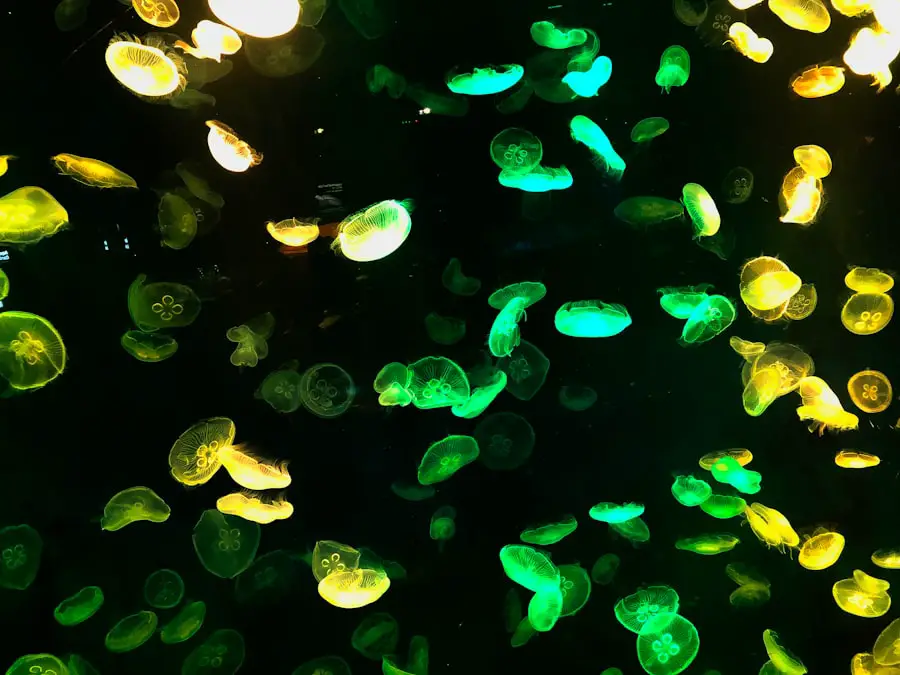
Jellyfish play a multifaceted role in marine ecosystems, acting as both predators and prey within the food web. As voracious feeders, they consume a variety of organisms, including zooplankton, small fish, and even other jellyfish. This predatory behavior helps regulate populations of these smaller marine creatures, maintaining a balance within the ecosystem.
In turn, jellyfish themselves are a vital food source for numerous marine animals, including sea turtles, certain fish species, and even seabirds. Their presence in the food web underscores their importance in sustaining marine biodiversity. Moreover, jellyfish contribute to nutrient cycling within marine environments.
Phytoplankton forms the base of the marine food web, supporting a wide range of marine life. Additionally, when jellyfish die and sink to the ocean floor, their bodies provide nourishment for scavengers and decomposers, further enriching the benthic ecosystem.
This dual role as both predator and prey highlights the interconnectedness of marine life and emphasizes the significance of jellyfish in maintaining ecological balance.
The Intriguing Behavior and Reproduction of Jellies
| Behavior | Reproduction |
|---|---|
| Jellies move by contracting and relaxing their bell-shaped bodies, allowing them to swim and navigate through the water. | Most jellies reproduce sexually, with males releasing sperm and females releasing eggs into the water. Fertilization occurs externally. |
| Some jellies exhibit bioluminescence, producing light through a chemical reaction within their bodies, which can be used for communication and defense. | After fertilization, the fertilized eggs develop into larvae, which then settle on a suitable surface and grow into polyps. The polyps eventually bud off and form new jellyfish. |
| Jellies have a unique feeding behavior, using their tentacles to capture prey, including small fish and plankton, and then transferring the prey to their mouths for digestion. | Some jellies are capable of asexual reproduction, where a polyp can bud off and form a new jellyfish, allowing for rapid population growth under favorable conditions. |
The behavior of jellyfish is often characterized by their passive drifting through ocean currents; however, they exhibit intriguing patterns when it comes to reproduction and movement. Jellyfish have a complex life cycle that includes both sexual and asexual reproduction stages. Most species begin their life as a polyp attached to a substrate, where they can reproduce asexually by budding off new polyps.
Eventually, these polyps undergo a process called strobilation, where they develop into free-swimming medusae that are released into the water column. During the sexual reproduction phase, adult medusae release sperm and eggs into the water, where fertilization occurs externally.
The timing of reproduction can be influenced by environmental factors such as temperature and food availability, leading to synchronized spawning events among populations. This phenomenon not only increases the chances of successful fertilization but also ensures that young jellyfish have access to abundant food sources as they grow.
The Sting of Jellies: Understanding their Venom
The venom of jellyfish is one of their most defining features and serves multiple purposes in their survival strategy. Jellyfish possess specialized cells called cnidocytes that contain nematocysts—tiny capsules filled with venom that can be rapidly ejected when triggered by contact with prey or threats. The composition of jellyfish venom varies significantly among species; some have mild stings that cause minor irritation while others possess potent toxins capable of causing severe pain or even death.
For example, the box jellyfish (Chironex fleckeri) is infamous for its highly toxic venom, which can lead to cardiac arrest in humans within minutes of being stung. Conversely, species like the moon jellyfish (Aurelia aurita) have relatively harmless stings that are often imperceptible to humans. Understanding the mechanisms behind jellyfish venom has become an area of active research, with scientists exploring potential medical applications for pain relief and treatment of various conditions based on the unique properties of these toxins.
Human Interactions with Jellies: From Aquariums to Research
Human interactions with jellyfish have evolved significantly over time, ranging from fascination to fear. In recent years, aquariums around the world have embraced jellyfish as captivating exhibits due to their ethereal beauty and mesmerizing movements. Visitors are often drawn to displays featuring various species illuminated by colorful lights that enhance their bioluminescent qualities.
These exhibits not only educate the public about jellyfish biology but also raise awareness about their ecological importance. In addition to aquarium displays, jellyfish have become subjects of scientific research aimed at understanding their biology and ecological roles. Researchers study jellyfish populations to monitor changes in marine ecosystems and assess the impacts of climate change on their distribution and behavior.
Furthermore, advancements in biotechnology have led to innovative applications derived from jellyfish research, such as bioengineering materials inspired by their unique structures or exploring their venom for potential pharmaceutical uses.
The Threat of Jellyfish Blooms and their Impact on Fisheries
Jellyfish blooms—massive increases in jellyfish populations—have become a growing concern for marine ecosystems and human activities alike. These blooms can occur due to various factors such as overfishing, nutrient pollution from agricultural runoff, and climate change-induced alterations in ocean temperatures and currents. When jellyfish populations explode, they can outcompete other marine organisms for food resources and disrupt local fisheries by consuming fish larvae and competing with commercially important species.
The economic implications of jellyfish blooms are significant; they can lead to reduced fish catches for commercial fisheries and increased operational costs due to clogged fishing nets or damage to equipment caused by large swarms of jellies. In some regions, such as parts of Japan and the Mediterranean Sea, fishermen have reported drastic declines in fish populations attributed to jellyfish predation. As these blooms become more frequent and intense due to anthropogenic influences, understanding their causes and developing management strategies will be crucial for sustaining both marine ecosystems and fisheries.
Conservation Efforts and Future Research in the World of Jellies
As awareness grows regarding the ecological significance of jellyfish and the challenges posed by blooms, conservation efforts are increasingly focusing on these enigmatic creatures. Initiatives aimed at monitoring jellyfish populations are being implemented in various regions to better understand their dynamics and predict potential blooms. Collaborative research efforts involving marine biologists, ecologists, and policymakers are essential for developing effective management strategies that address both conservation needs and human interests.
Future research on jellyfish holds promise for uncovering new insights into their biology and ecological roles. Investigating how environmental changes impact jellyfish populations will be critical for predicting future trends in marine ecosystems. Additionally, exploring the potential applications of jellyfish-derived materials in biotechnology could lead to innovative solutions in various fields ranging from medicine to materials science.
As our understanding of these fascinating organisms deepens, it will be essential to balance conservation efforts with sustainable practices that ensure the health of marine ecosystems for generations to come.
If you’re a fan of seafood like Jellies, you might enjoy reading about Cutler & Co’s Wood-Grilled Prawns with Fried Garlic and Chilli Oil. This article explores a delicious recipe that combines the flavors of prawns with garlic and chili oil, creating a mouthwatering dish. Check it out here for some culinary inspiration.
FAQs
What are jellies?
Jellies, also known as jellyfish, are free-swimming marine animals that belong to the phylum Cnidaria. They are found in oceans all over the world and come in a variety of shapes, sizes, and colors.
What do jellies eat?
Jellies primarily feed on small fish, zooplankton, and other jellyfish. They use their stinging tentacles to capture and immobilize their prey before consuming it.
Are jellies dangerous to humans?
While most jellies are harmless to humans, some species can deliver a painful sting. The severity of the sting varies depending on the species, with some jellies being capable of causing serious injury or even death.
How do jellies reproduce?
Jellies have a complex life cycle that involves both sexual and asexual reproduction. They release eggs and sperm into the water, where fertilization takes place. The resulting larvae then develop into polyps, which eventually bud off and form new jellyfish.
What is the ecological role of jellies?
Jellies play an important role in marine ecosystems as both predators and prey. They help to control populations of small fish and zooplankton, and also provide food for larger marine animals such as sea turtles and some species of fish.
Can jellies be kept as pets?
Some species of jellies can be kept in specially designed aquariums, known as jellyfish tanks. These tanks provide the necessary water flow and filtration to keep the jellies healthy, and are becoming increasingly popular as pets.